
August 1926: Soroptimist Takes Its First Steps Toward Federation
In August 1926, representatives from 10 Soroptimist clubs gathered in Oakland, California, to consider a question that would shape the organization’s future: Should the independent clubs come together as a federation? Although the delegates did not leave the meeting with a federation in place, they took the first formal steps toward creating a unified, international organization.
From Independent Clubs to a Shared Vision
Beginning in 1921 with the Alameda County Soroptimist Club (later renamed SI/Oakland) and continuing through mid-1926, Stuart Morrow or his hired agents chartered 16 independent clubs—13 in the United States, one in Canada, one in the United Kingdom, and one in France. One other club in the UK also chartered in 1926, but Morrow’s involvement, if any, is not documented in our SIA archives. At the time of their chartering, Morrow stated to each club that they were free to undertake federation with other Soroptimist clubs in the future. He had filed incorporation and other legal instruments that gave him control over the Soroptimist name and management.
The Movement Toward Federation Begins
December 1925 marked the beginning of action toward federating the independent Soroptimist clubs into an organization of clubs. Morrow asked the leadership of the Alameda County Soroptimist Club whether the time had come to begin discussing the formation of a state, national or international organization.
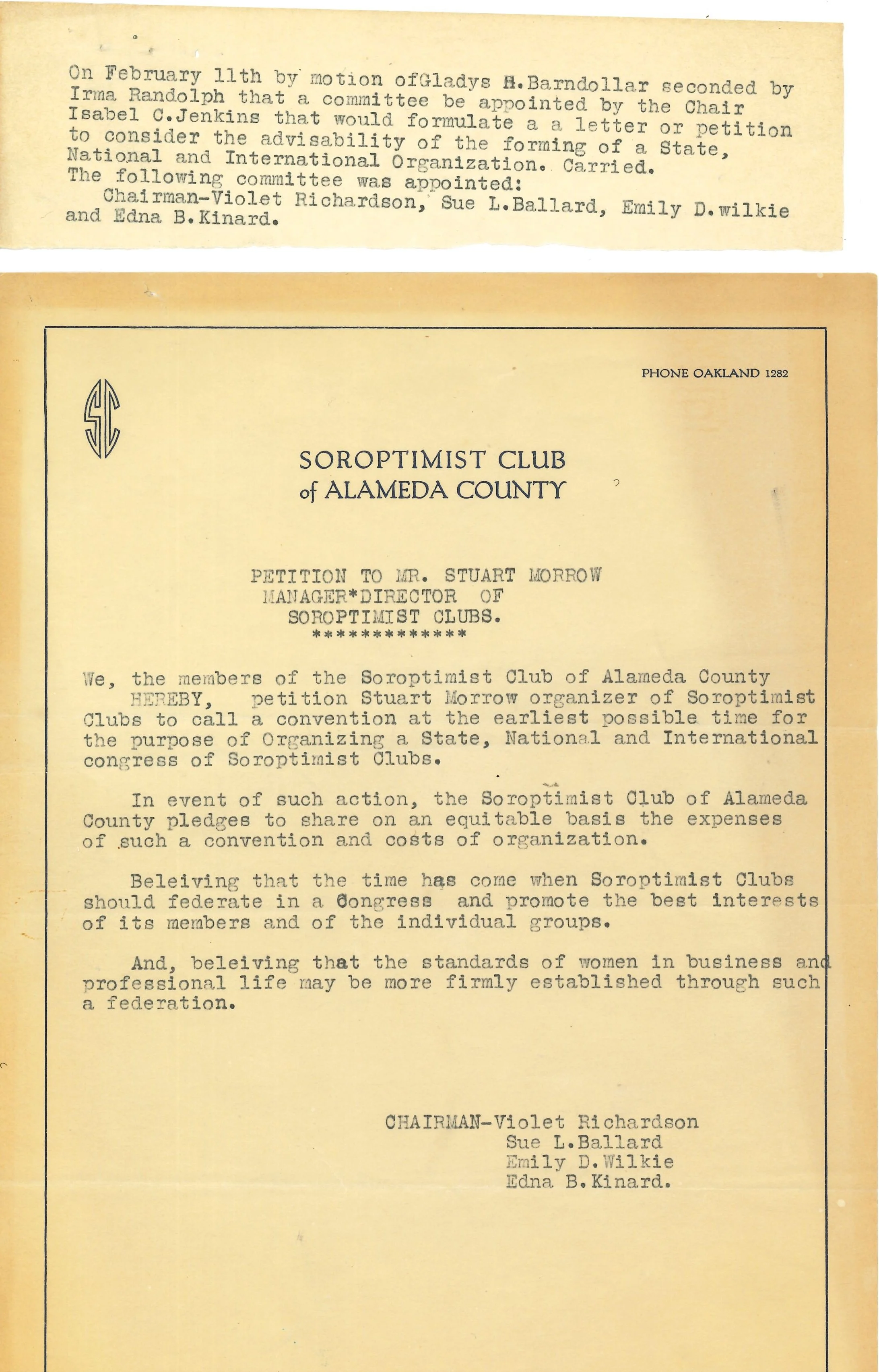
Formal work began on February 11, 1926, when a charter member of the Alameda County club introduced a motion for the club to undertake this effort. A second motion followed a week later, calling for the club to petition Morrow to convene a conference about the possible creation of a state, national or international organization.
Throughout the spring and early summer, correspondence between Morrow and Helana Gamble showed increasing preparation for a late-summer meeting. Gamble was a member of the Alameda County club whom Morrow had appointed as his California state manager to assist with chartering clubs.
Ten Clubs Convene in Oakland
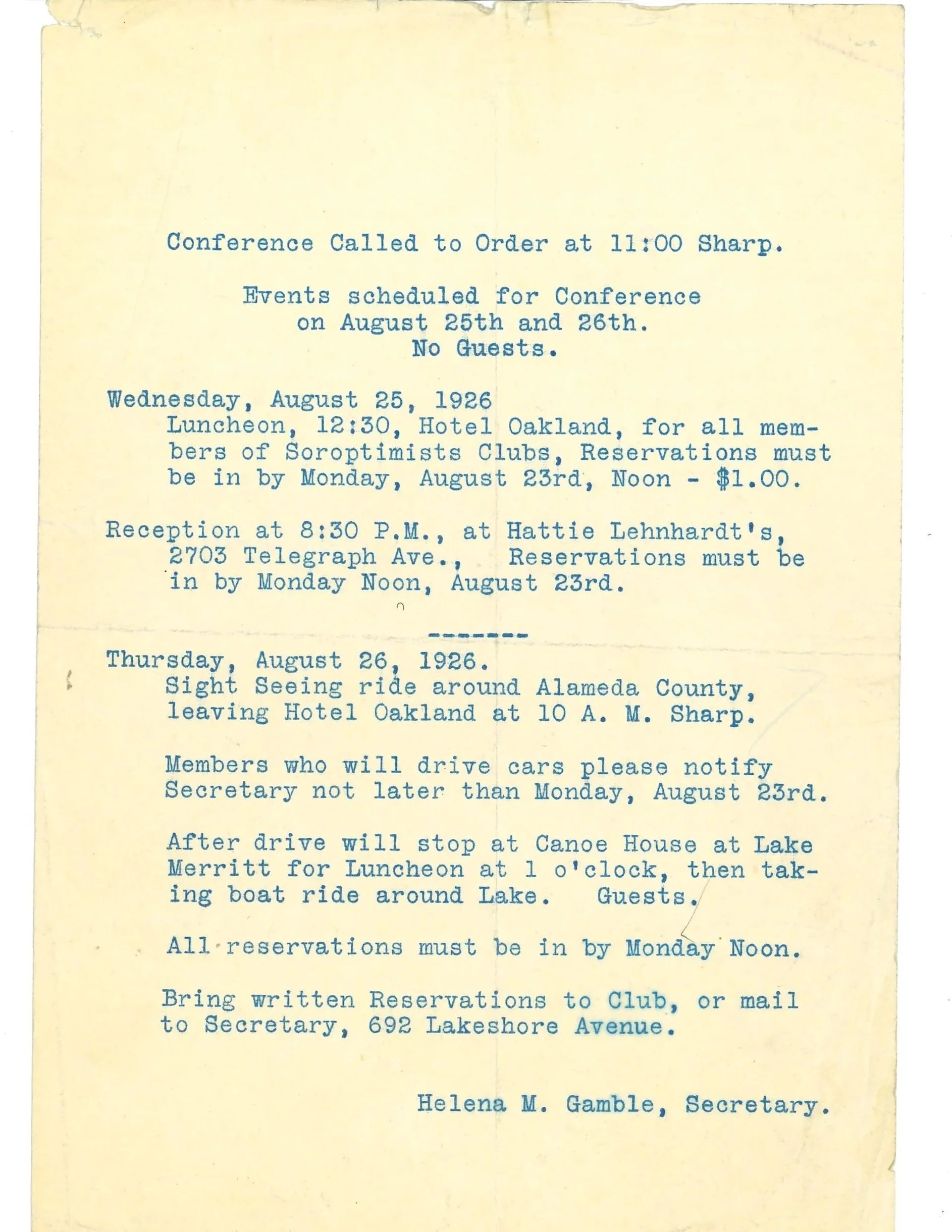
In early July, the Alameda County Soroptimist Club invited clubs along the Pacific Coast of North America to meet. On August 25, 1926, delegates from 10 clubs convened in Oakland—Alameda County, San Francisco, Los Angeles, Sacramento, Long Beach, San Jose, Seattle, Portland, Spokane, and Vancouver.
Morrow was unable to attend because he was working on the charter of a Soroptimist club in Detroit. His absence made the work of the conference more ambiguous, as there were no solid legal answers to some of the questions.
After handling some parliamentary issues, the discussion began with several questions:
Should organizational efforts be confined to the Pacific Coast region?
Should this should be a regional/Pacific Coast effort or a national or international organization?
What was the purpose of having a federation?
“We Need One Another”
Iris Lutz, a delegate from the Portland club, noted:
“I very much favor federation personally and from the standpoint of the Portland club. I can only talk for our own individual need. I believe that if we do not have a federation it will mean disintegration. I think that is true of every club. We have a particular situation in our town—in fact, we are clubbed to death. We have one organization of business women, a very splendid group, that meets the need of the city of Portland for business women. We were approached from a standpoint of international organization. No one would have sold me the organization under any other circumstances. The thing that was placed upon that basis—that it was not a local matter—that it was a group of women throughout the United States. We need one another, and we need to federate. I think it should be taken care of as quickly as it can, in decency and in order. I do not feel it should be a localized thing in any shape or form. I think it should be of international scope if it is to be anything. We have need for them, when we are able to thrash this thing out and get at a basis for federation. I do not think we are in a position to federate at this time with this group. I do think it is possible for us, as representatives of the Pacific Coast, to have resolutions to present to our individual clubs and to the clubs which were not able to attend this meeting, so that each one will have an opportunity to consider and discuss the matter, and I think we should send something back to every club that is now organized and that a future conference should be considered. They should all be invited to attend one, and if they do not come, that is not our fault.”
Seeking Control of the Organization
While Iris Lutz ably captured many delegates’ sentiments that federation, especially on an international level, was eminently desirable, the crux of the matter for many delegates—control of the organization—was captured by Mary Dry Boldemann of San Francisco:
“Speaking for our club, we are in favor of federation but only on the condition that we gain absolutely the full control of the charter. We feel Mr. Morrow has derived all the money to which he is entitled. He has gone to every club and made his own arrangements with them. It would seem that, after all, progress is necessary, and we must have federation—that is my personal sentiment in the matter. If we gain control of the charter, international federation would be my wish, and then we can go out and say that our club means something, and that is what we have wanted to do.”
Turning Discussion Into Action
Following further discussion, the delegates created six committees to guide the next steps:
A general committee to oversee the work
A constitution and bylaws committee
A committee to negotiate with Morrow regarding his rights to the organization
A club communication committee to determine where all existing clubs stood on federation
A ways and means committee to recommend how to establish and fund an initial treasury
A committee to organize another conference in 1927
During the conference, Violet Richardson Ward—the first president of the Alameda County club—served in the difficult dual role of club delegate and Morrow’s personal representative. She had received no instructions from Morrow.
The delegates moved and approved instructing Violet Richardson Ward to contact Morrow and obtain from him a definite proposition to surrender absolutely and finally all rights he had to existing or future clubs, the name of the organization, and any other rights pertaining to the organization. The proposition was to be sent to every Soroptimist club within 30 days.
The delegates also determined it would be helpful to have a small treasury of funds to carry out the work of creating a federation, perhaps charging between 50 cents and $2 per current member, but did not endorse any specific motion to ask clubs for that money.
The Need for Common Practices
The meeting concluded with questions about how clubs handled specific items, like how active, associate or honorary members were defined, and how professional classification lists were maintained? If clubs were willing to take in a member from another club who moved from her original city, and if that member would be charged another initiation fee? If Parliamentarians were members, or were hired professionally from outside the ranks of membership? If dues were paid in advance?
These questions highlighted the need for some uniform procedures across clubs that made forming a federation so imperative.
Having determined that Chair Mary Dry Boldemann and Secretary Florence Curry should continue in these roles for any upcoming conference, the meeting adjourned. The delegates were treated to a day of activities around San Francisco and Oakland the following day, and returned to their clubs to continue the work of creating a federation to bring the clubs together.
A Foundation for the Future
The August 1926 conference did not immediately establish a federation, but it transformed a shared aspiration into an organized course of action. By forming committees, reaching out to every club and confronting questions of ownership, governance and common practices, the delegates laid the groundwork for Soroptimist’s next chapter. Their belief that the clubs needed one another—and that Soroptimist should be international in scope—helped move the organization toward the global federation it would become.
SHARE THIS:
MORE BLOGS YOU MAY LIKE: